EN
EN  ID
ID  AR
AR  ZH
ZH 

HUMANITIES – (20/12/2024) The Faculty of Humanities, State Islamic University of Malang continues to demonstrate its commitment to implementing an Outcome-Based Education (OBE) curriculum. OBE is an educational system approach that focuses on learning achievement, where education does not only emphasize the completion of material, but also the results or outcomes of learning. This curriculum is designed to support an innovative, effective, and interactive learning process, with the aim of preparing students to face global challenges.
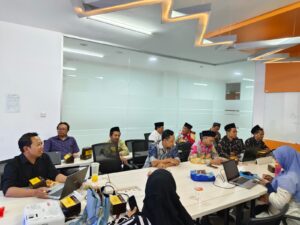
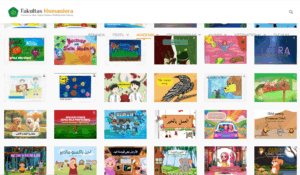
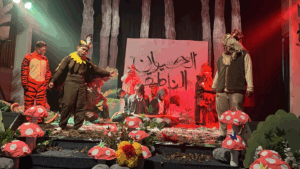
The Arabic Language and Literature (BSA) Study Program is one of the study programs at the Faculty of Humanities that adopts this approach seriously. One concrete implementation is seen in the Al-Kitabah al-Ibdaiyah course, which not only provides an understanding of the theory and concept of creative writing but also requires students to produce real works in the form of illustrated stories. These stories are written in two languages, namely Arabic and Indonesian, thus adding a multilingual dimension to their work.
The course taught by Dr. M. Faisol has succeeded in producing hundreds of creative works produced directly by students. In its implementation, students not only gain insight into writing theory, but also direct training to produce products that are relevant to the creative industry world. This approach has received positive appreciation from students, who feel helped to develop their creativity.
One of the students, Subarkah, said that this course really inspired her to create. “The final product is a picture story produced by all students. This course really opened our horizons about how creativity can be utilized in the creative industry,” she said.
Meanwhile, Nabil, who also took this course, added that this experience provided a new perspective on career opportunities in the creative sector. “Studying at BSA is not only focused on literary or linguistic theories, but the experience of writing picture stories leads to opportunities in the creative industry world,” he said.
The application of the OBE curriculum in this course also shows how learning in the Faculty of Humanities is directed to support 21st century skills, including creativity, collaboration, and critical thinking skills. That way, students are not only equipped with academic skills, but also practical skills that are relevant to industry needs.
Head of the BSA Study Program, Dr. Abdul Basid, M.Pd., hopes that innovative steps like this can continue to be implemented in other courses to encourage students to produce new works. “The success of the al-Kitabah al-Ibdaiyah course is expected to be an inspiration for other course instructors in developing a results-oriented learning approach,” he said.
The OBE-based curriculum implemented in the Faculty of Humanities is real evidence of how higher education can have a real impact on the development of student creativity, while preparing them to face challenges in the professional world. The Faculty of Humanities continues to be committed to being a pioneer of innovation in outcome-based learning. [aii]